
Organize and analyze
Bibliographic Coupling
Find papers linked by shared references.
Create an accountCreate your account, then complete verification to start using SciMaps.
What you can explore
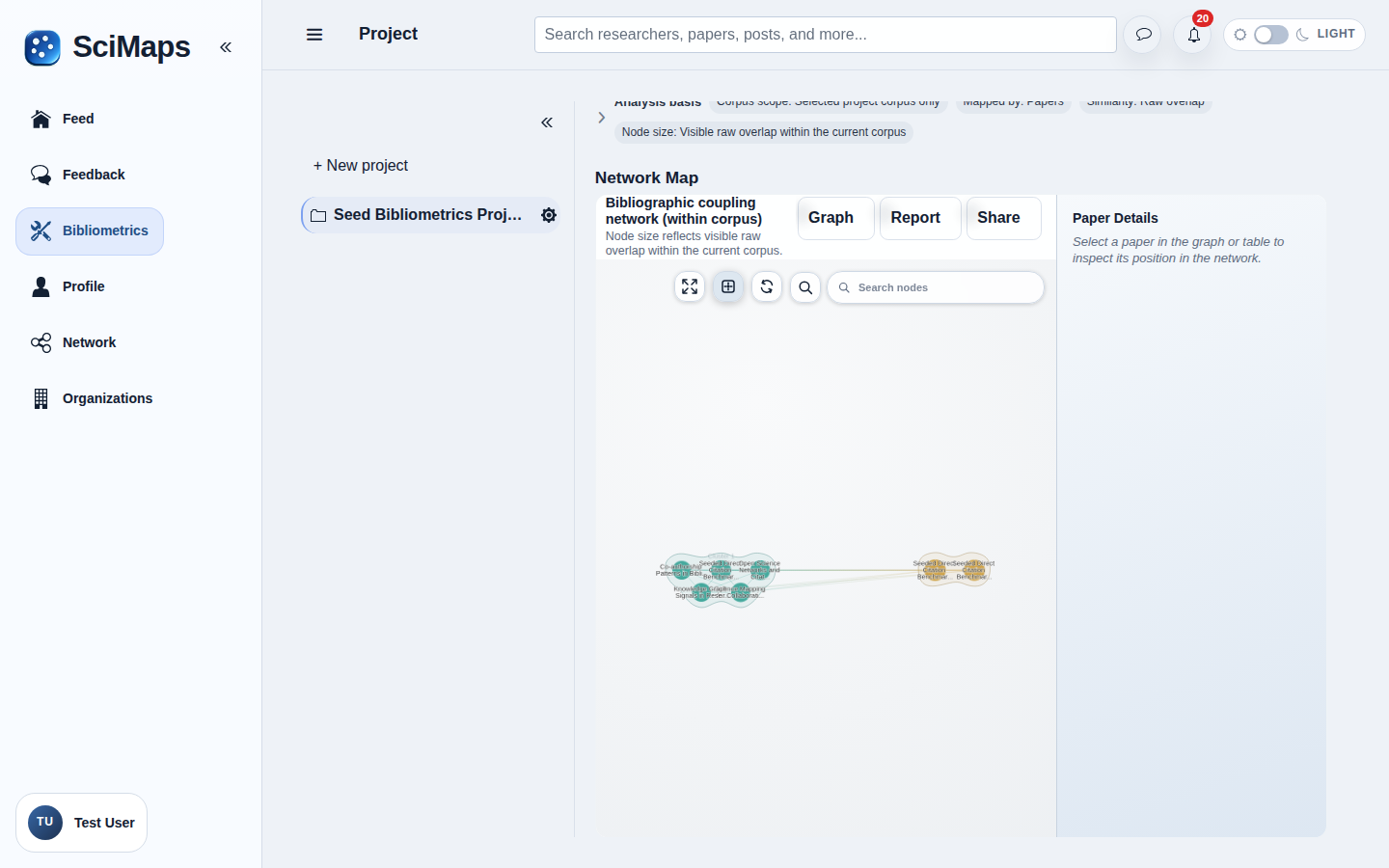
A network connecting papers through references they have in common.
What you need
Selected project sources with usable reference lists.
How to use it
- Choose the papers to compare.
- Open Bibliographic Coupling in Bibliometrics.
- Inspect shared references and thresholds; open AI Insights for optional AI-assisted interpretation.
Illustrative example
Suppose Papers P and Q in your selected collection both cite References A and B. The papers P and Q are nodes; their link records shared references. This is bibliographic coupling even if P never cites Q. Missing reference lists and thresholds affect the link; shared references do not mean identical findings.
Interpretation and limitations
Shared references are evidence of related citation context, not identical findings. Missing reference lists change link strengths. Results describe the selected sources and available metadata; they do not represent all research in a field.
Related tools
Related guides
Create an accountCreate your account, then complete verification to start using SciMaps. Already have access? Sign in to SciMaps.