
SciMaps guide
Co-citation vs Bibliographic Coupling
Published by SciMaps · Updated
Compare co-citation and bibliographic coupling with the same worked reference example, and choose a method for a selected literature collection.
Two ways to read reference relationships
Co-citation asks which references are cited together. Bibliographic coupling asks which papers share references. They use different nodes and answer different questions, even when they start from the same selected collection.
Use co-citation to explore shared reference context around cited works; use bibliographic coupling to compare the reference context of selected papers. Neither method proves that connected works agree, have the same findings or cite each other.
Illustrative example
In a deliberately small selected collection, Paper P cites References A and B, and Paper Q also cites References A and B. Paper R cites only Reference C. For the SciMaps paper co-citation view, include the cited works A, B and C in the selected collection as well: its paper nodes are restricted to the retained analytical corpus. These letters are invented labels, not findings from a real dataset.
- In the co-citation view, A and B are reference nodes. They have a link because P and Q cite them together; the raw shared-citation count in this example is two.
- In the bibliographic coupling view, P and Q are paper nodes. They have a link because they share A and B; the raw shared-reference count is two.
- R has no coupling link to P or Q in this example. That does not mean R is irrelevant. The visualization may omit isolated nodes or weak links depending on settings.
The example uses simple raw counts. Displayed strengths may use normalization or other method settings; check the analysis notes instead of assuming the number on screen is this count.
| Question | Co-citation | Bibliographic coupling |
|---|---|---|
| What are the nodes? | Cited references A and B | Selected papers P and Q |
| What creates a link? | A selected paper cites both references | Two papers share a reference |
| What would you read next? | The linked references and their citing context | The linked papers and the references they share |
| What can remove a link? | Missing cited-reference metadata or thresholds | Incomplete reference lists or thresholds |
A practical task sequence
- Define and select a collection with usable reference metadata.
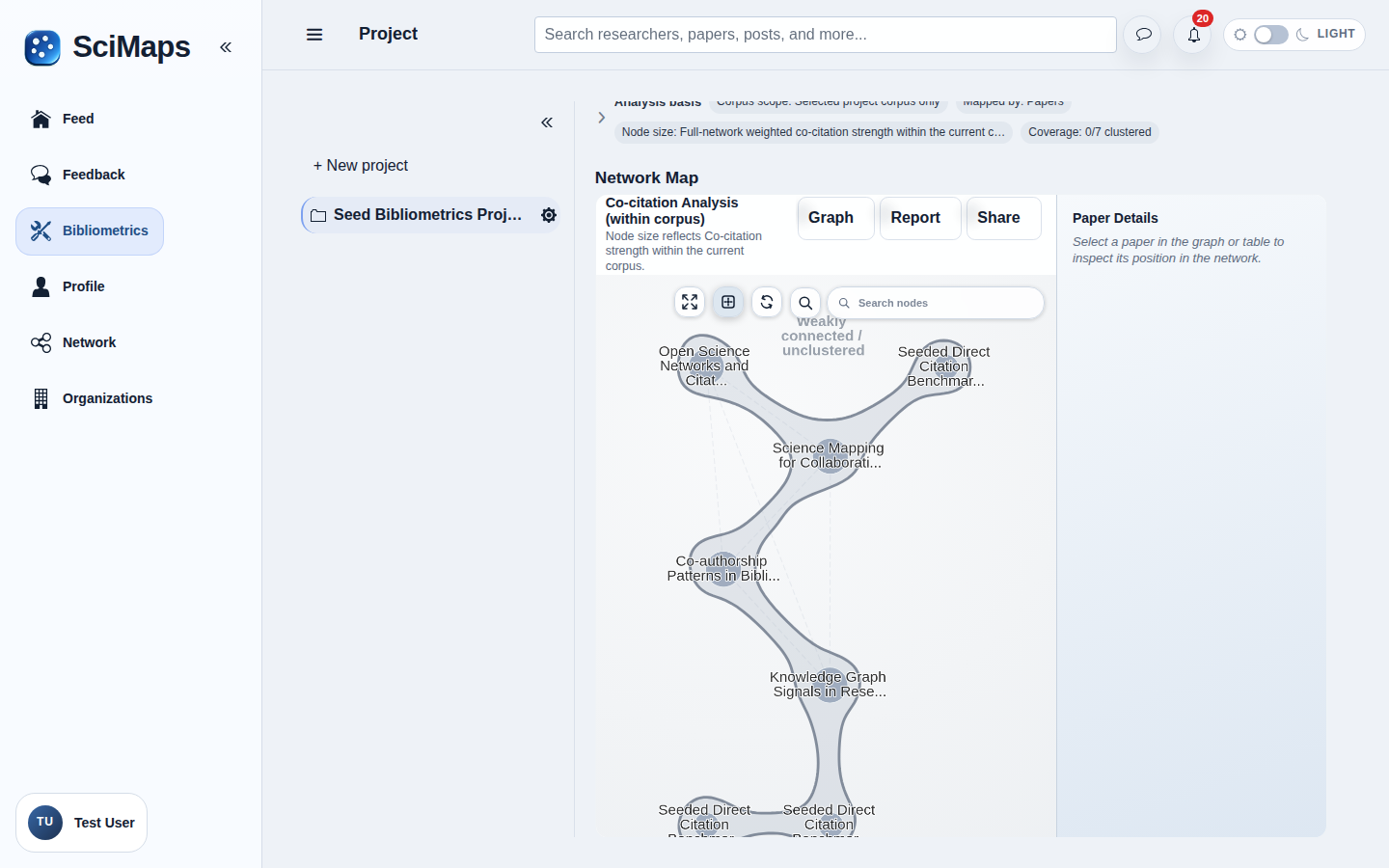
- Open Co-citation for the reference view or Bibliographic Coupling for the paper view.
- Check node type, coverage, settings and thresholds before reading clusters.
- Inspect the linked records and read the sources; use Direct Citation when you need citing-to-cited direction.
Individual research example
A researcher selects a defined collection of 60 eligible review-topic papers. They compare papers through coupling, then use co-citation to inspect shared reference context. Each cluster becomes a reading prompt, not an automatic literature-review conclusion.
Institutional example
A library analyst selects a defined collection of 150 topic-and-year-matched records for a research-center workshop. They compare reference contexts within this selected collection, with documented coverage. The map does not evaluate the institution's entire output or staff performance.
Limitations
Reference coverage can differ by publication year and provider. Matching errors, normalization and thresholds change visible relationships. Co-citation can change as more citing papers enter the collection; coupling reflects the references available for the compared papers. Neither network measures quality, consensus or completeness.
References
- Small (1973), Co-citation in the scientific literature — the original co-citation method.
- Kessler (1963), Bibliographic coupling between scientific papers — the original coupling method.
Related tools
Related guides
Try the workflow in SciMaps
Build a project collection and select the sources for your analysis.
Create an accountCreate your account, then complete verification to start using SciMaps. Already have access? Sign in to SciMaps.