
SciMaps guide
Co-authorship and Research Collaboration Networks
Published by SciMaps · Updated
Explore author collaboration in a selected literature collection while checking identity ambiguity, affiliation coverage and counting limits.
Shared papers provide one view of collaboration
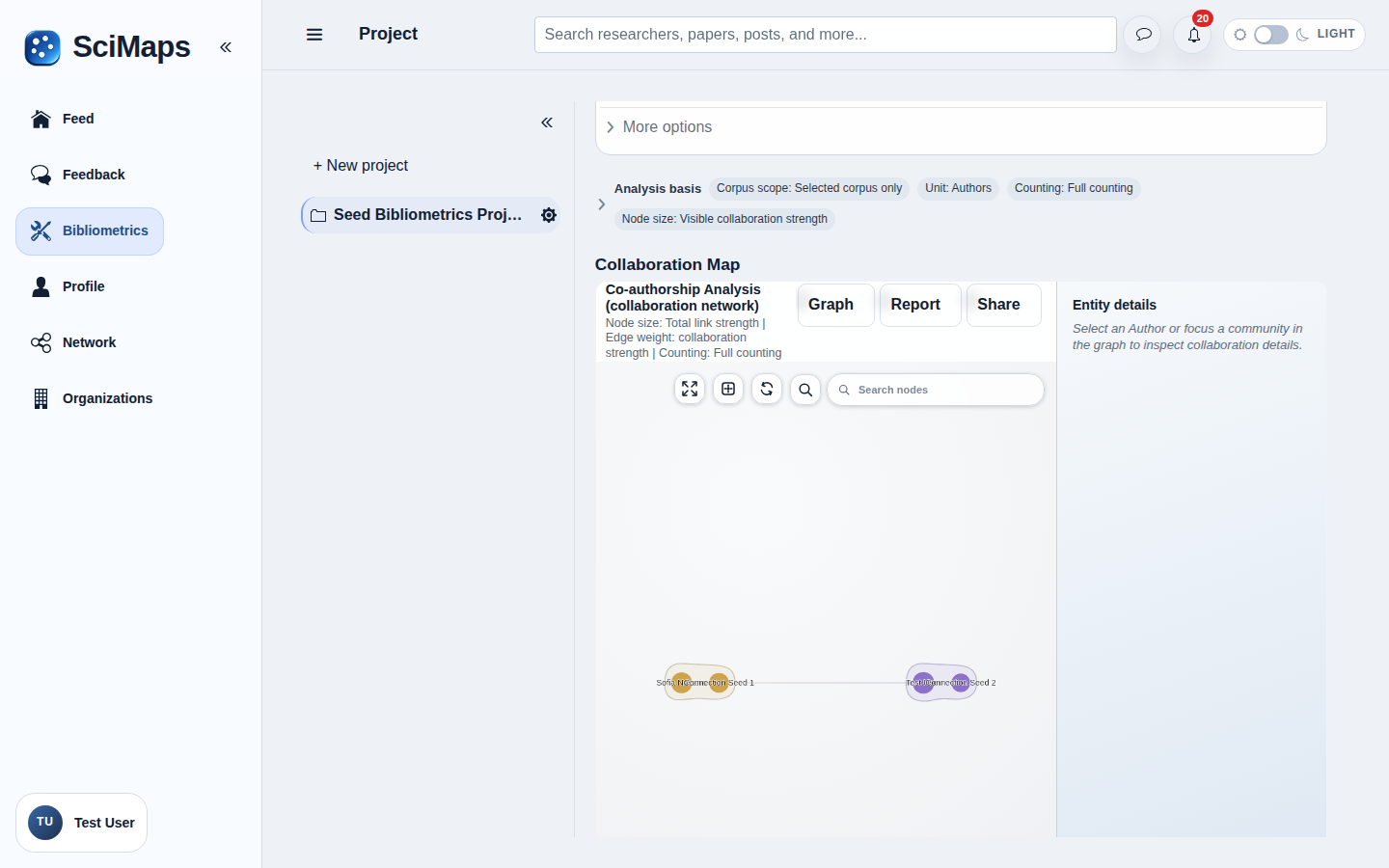
A co-authorship network connects authors who appear together on papers in the selected collection. In the author view, nodes represent authors and links represent shared authorship. It can help you inspect collaboration patterns, but it cannot describe all mentoring, data sharing, informal work or other contributions.
A practical task sequence
- Define the topic, period and inclusion rules; select the eligible project sources.
- Review author identifiers, names and available affiliations. Similar names can refer to different people, and one person can appear under several names. Do not infer identity from name alone.
- Open Co-authorship, inspect the selected entity type and review settings and thresholds.
- Inspect shared papers and available research profiles to check the context behind links. Use Country Production only with its affiliation coverage and counting context.
- Document the selected collection, author matching limitations and visible network scope when reporting patterns.
Illustrative example
Suppose selected Paper P lists Authors A and B, and Paper Q lists Authors B and C. The author network has links A–B and B–C. There is no observed A–C co-authorship link in these records. That does not establish that A and C have never worked together.
Now suppose two records list “J. Lee.” Without reliable identifiers and context, they may represent one author or two. Merging them could create a false bridge; splitting one person's records could hide a connection. A threshold requiring two shared papers would also hide both one-paper links in the invented example.
Individual research example
A researcher selects a defined collection of 70 papers on a topic to find author groups for further reading. They verify shared papers and identities before drawing conclusions about who collaborated. Network prominence does not establish expertise or contribution.
Institutional example
A library team selects a defined collection of 140 publications meeting stated affiliation, topic and year criteria for a collaboration workshop. They review author and affiliation matches, then discuss observed shared authorship within those selected records. This is not a complete institutional collaboration evaluation or a staff ranking.
Limitations
Identity ambiguity, incomplete author lists, affiliation changes and missing records affect links. Multi-author papers can create many connections. Raw counts depend on collection size and counting choices. A central author is structurally connected in the analyzed network; this does not prove leadership, quality or the size of an individual contribution.
References
- Newman (2001), The structure of scientific collaboration networks — constructing networks from shared authorship.
- Hicks and colleagues (2015), The Leiden Manifesto for research metrics — contextual and transparent use of indicators.
Related tools
Related guides
Try the workflow in SciMaps
Build a project collection and select the sources for your analysis.
Create an accountCreate your account, then complete verification to start using SciMaps. Already have access? Sign in to SciMaps.